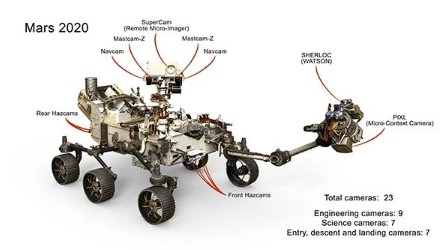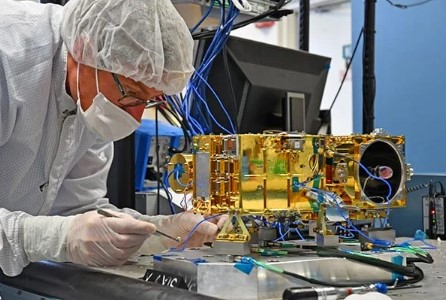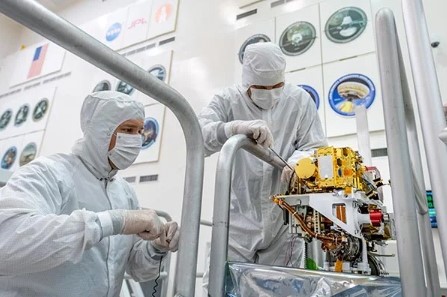
NASA’s Perseverance Rover mission is to search for signs of previously or currently habitable conditions on Mars and for signs of past microbial life. The SuperCam utilizes remote-sensing techniques to conduct minerology analysis of both the environment and samples within the robotic-arm workspace. The SuperCam is a technological improvement over Curiosity’s ChemCam, as it adds two new techniques for determining mineralogy a color image and an acoustic system to remotely determine physical properties of targets. The SuperCam includes a broad range of spectroscopy instruments, some of which utilize thermoelectric coolers (TECs) that use the Peltier effect to pump heat away from electronics and maintain tight temperature control. The TECs need to reject heat to help protect the electronics vital to minerology observations.
Heat pipes are a common component in many electronic assemblies used to either spread or transport heat. Many applications use heat pipes to prevent heat build-up and potential damage to sensitive and expensive equipment by quickly moving heat away to cooler regions. While most heat pipes are robust and straightforward; customizations and material selections enable these straightforward solutions to solve more complex challenges, applications and operating environments.
For the Perseverance Rover, maintaining a safe operating temperature of data collection equipment is paramount to the success of the rover. There is no way to mantain or and repair to the rover once it’s launched, so thermal management systems must reliably perform in extreme temperatures common on Mars over the entire lifetime of the rover. Failure is not an option. Eaton’s heat pipes are an ideal solution for space applications like these as they’ve been proven to operate consistently over decades of operation with no active moving parts.
Mars is much colder than Earth but there is less atmosphere, so natural convection air cooling is much slower putting electronics at risk of overheating despite the colder environment. This colder environment makes common copper-water heat pipes unsuitable for the Mars Rovers. To solve the performance and environment challenge, Eaton uses our engineering expertise to feature methanol as an alternative working fluid for passive two-phase cooling, which doesn’t freeze at rover temperatures.
Eaton has previous experience fabricating solutions for Mars missions, making us a solid partner in developing reliable thermal management solutions that meet the demands of reliably performing on Mars. We leveraged our understanding of Martian environment design challenges to create a new heat pipe solution in partnership with Los Alamos National Labs for the SuperCam module. The SuperCam module enables critical imaging, mineral, and chemical analysis, a central portion of the Perseverance Rover mission.
Los Alamos National Labs approached Eaton to help transport a total 6W of heat away from the charge-coupled devices (CCDs, optical detectors) within the SuperCam Module to be transferred to thermoelectric coolers (TECs). As a team, LANL and Eaton developed three heat pipe assemblies to cool 2W each, constructed with two 5mm diameter plated copper-methanol heat pipes. This enables a stable ~20°C of cooling below the temperature of the Rover Accessory Mounting Plate (RAMP).*
As NASA is making final preparations for the launch, Eaton continues to develop and fabricate solutions for upcoming Martian projects. We’re looking forward to a successful launch on July 22nd (or August 11th at the latest) and the eventual deployment of the Perseverance Rover on Mars in February 2021. Good Luck NASA and thank you Los Alamos National Laboratory for the opportunity to be a part of history!
Are you working on a project that has demanding thermal management requirements or must survive harsh environments? Contact us for your challenging applications!