Scaling lower-carbon materials at the Eaton Schrems plant

Location: Schrems, Austria
Challenge: Eaton sought to advance the sustainability of its high-volume products by reducing material-related emissions without affecting product performance or operations.
Solution: The Schrems plant switched to a verified reduced-product-carbon-footprint (rPCF) nylon resin that served as a drop-in replacement requiring no redesigns or production changes.
Result: The transition is expected to cut annual carbon emissions by approximately 1,600 metric tons while enabling lower-carbon products with no production disruption.
From a product perspective, this was a critical step. We were able to reduce the material carbon footprint of one of our highest‑volume product platforms without compromising performance, safety, or qualification requirements. That gives our customers a lower‑carbon option they can adopt immediately…and it gives us a scalable path to expand this approach across the portfolio.
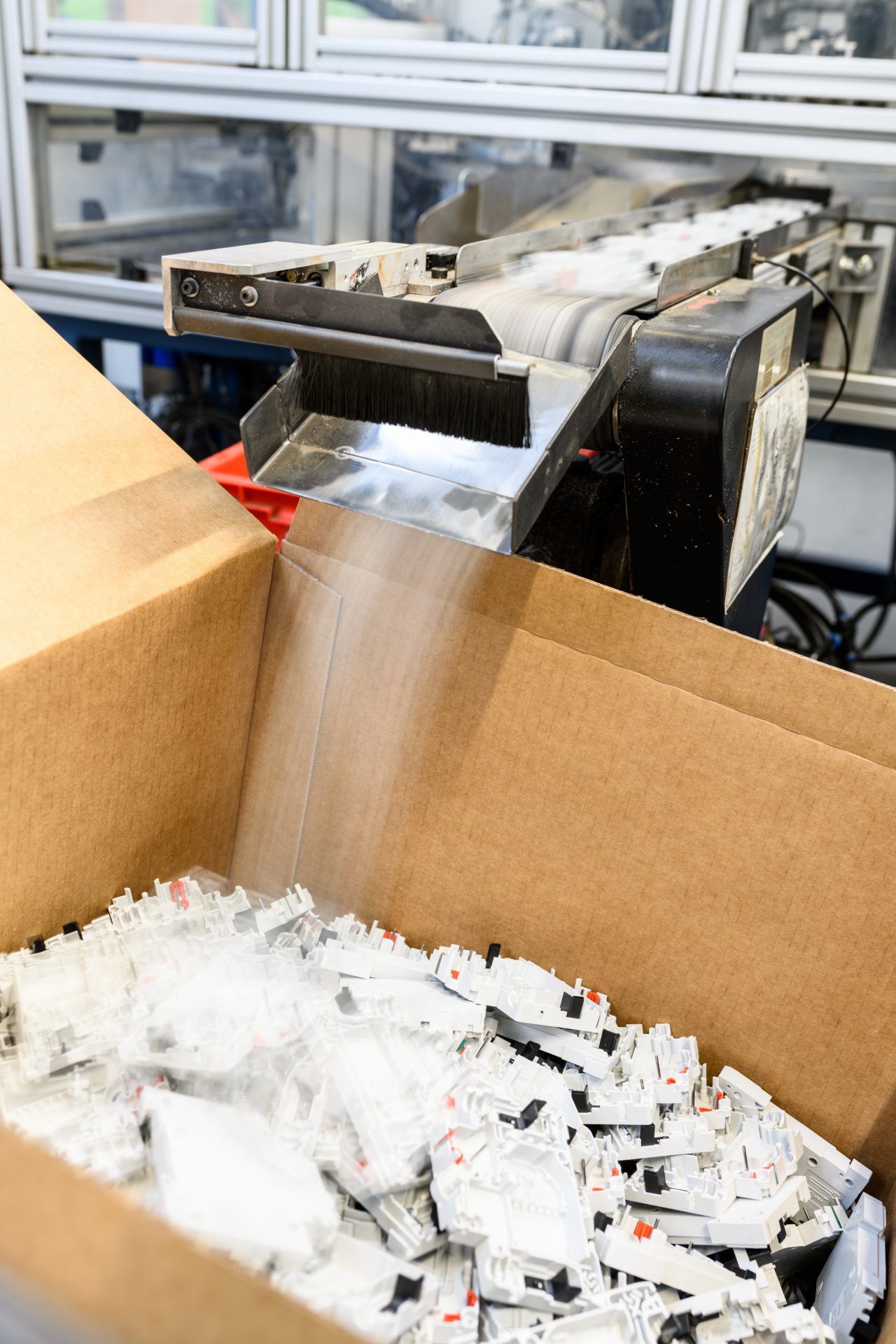
Eaton’s manufacturing operations, particularly high‑volume products like miniature circuit breakers (MCBs), rely heavily on engineered plastics whose production traditionally carries a significant carbon footprint. As global customers increased expectations for lower‑carbon and clear sustainability disclosures, Eaton needed a solution that would:
Eaton’s progress in material decarbonization has been rooted in the strength of our long‑standing partnerships. Working with suppliers who share our commitment to sustainability has allowed us to pursue solutions that meaningfully reduce the carbon footprint of essential materials. In 2025, these collaborative efforts advanced further through a joint initiative to introduce reduced‑carbon‑footprint (rPCF) plastics into high‑volume product lines. Our strategic partners provided the capability to:
As a result, Schrems fully transitioned its highest‑volume nylon resin to an price alternative delivering reduced CO2 footprint to most MCB product series.
“From a product perspective, this was a critical step. We were able to reduce the material carbon footprint of one of our highest‑volume product platforms without compromising performance, safety, or qualification requirements. That gives our customers a lower‑carbon option they can adopt immediately…and it gives us a scalable path to expand this approach across the portfolio.” - Riccardo Di Federico, product line manager, Eaton.
Environmental impact: In its first year, Schrems introduced price material into production.
Commercial impact: This transition strengthens Eaton’s market position by enabling participation in new and existing segments that expect lower‑carbon products, reinforcing Eaton’s leadership as peers introduce similar sustainable materials.
“What’s exciting is that the shift to lower carbon materials isn’t just good for the planet… it’s good for the business. This move has real potential to drive meaningful sales growth, proving that responsible material choices can deliver measurable commercial results.” - Mustafa Huseyin, director of procurement, Eaton
Operational impact: Because the price resin is a true drop-in replacement, Schrems achieved the transition with zero production disruption, no redesigns, and no process changes.
These efforts signal that Schrems is only the beginning. As Eaton expands toward incorporating price materials annually and additional sites, including the new Dubai facility, prepare for similar transitions. The growing network of lower‑carbon manufacturing sites positions Eaton to deliver consistent environmental benefits, meet rising customer expectations, and accelerate sustainability impact across our entire footprint.
Eaton has already reduced greenhouse gas (GHG) emissions from its operations by 40% for Scope 1 and 2. Integrating lower‑carbon materials into high‑volume products only strengthens this momentum.
The Schrems plant demonstrates what happens when sustainability and business strategy move forward together. By selecting materials that deliver equivalent performance with verified emissions reductions, Eaton is building a more resource efficient, competitive, and resilient manufacturing system. One that benefits our customers, our business, and the planet. Serving as a powerful example of how we make what matters work.
We're making considerable progress in achieving our goals. See how we create long‑term value by delivering innovative solutions for our customers, operating responsibly across our value chain, investing in our people and communities, and leading with integrity.
 发送电子邮件

 MyEatonFAQs


