下载文档 () / 20
动力,因我们而不同*

Solar eclipse thermals: Radiation’s effect on weather

We generally take regular events for granted. Sometimes, it’s only when our daily routine is disrupted that we realize how much impact these everyday occurrences have on our lives. The big disruption in the US was the total solar eclipse that reaches coast to coast on August 21st, 2017. One thing that doesn’t come immediately to mind is the solar eclipse thermals and how it’ll effect weather on a local scale.

Solar eclipse thermals: The power of solar radiation

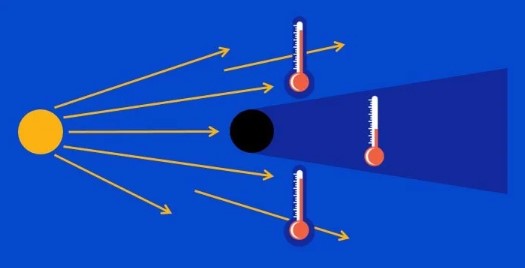
The only type of thermal energy we receive from the sun is radiation. When the moon moves in between the sun and the Earth,  solar radiation is blocked from the surface of the Earth. While this event is transient, the sheer amount of energy we receive from the sun is so monumental that even a few minutes without it can have drastic effects.

Imagine sitting at a campfire on a cold night. You’re enjoying the heat from the fire in front of you, but your friend stops to chat with you, stopping between you and the fire.  Your friend is now absorbing that radiation and you start to feel the chill of the evening. Now, replace the campfire with the sun and your friend with the moon. The scale of this momentary chill increases monumentally.

eaton-large-solar-radiation-shadow-temperature.jpg

Solar Radiation Temperature Effect Illustration

Humans will experience a noticeable temperature drop when the umbra sweeps over them. Dr. Mitzi Adams recorded a 15°F (8.3°C) drop in temperature during the total solar eclipse in Lusaka, Zambia on June 21st, 2001. Humans can expect the same for the 2017 total eclipse in the US. In fact, NASA’s article details all the different ways that you can measure your local temperature drop when you observe the solar eclipse this year.

Solar eclipse thermals: The resulting convection

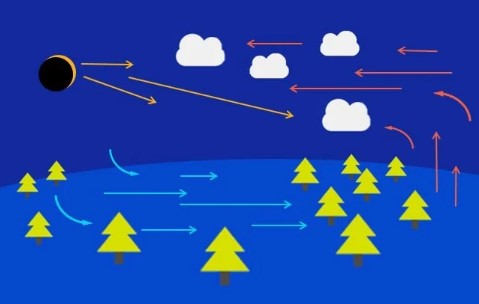
With local cooling, fluids are also react to the solar eclipse on a larger scale than just temperature change. The biggest effect is natural convection generated from the induced pressure differential. With the penumbra and umbra area receiving less thermal energy, the air in those regions will cool and sink due to buoyancy forces. This will draw air in from higher up in the atmosphere from outside of the penumbra. This may bring in moisture that cools upon contact with this suddenly chilled air. When the moisture cools, it may cool enough to condense into clouds. Extra breeze and clouds are additional manifestations of solar eclipse thermals.
eaton-large-solar-radiation-natural-convection-weather.jpg
Solar Eclipse Driving Local Natural Convection Illustration