Designing custom liquid cold plates
When the thermal performance requirements is not uniform across the entire cold plate, designers must consider pressure drop and cost considerations to accommodate their specifications. The thermal map or distribution of heat loads may have one or several areas with high heat loads. If there are pressure drop, cold plate surface temperature uniformity, special shape or interface requirements or cost limitations that eliminate a standard cold plate design, then a custom cold plate is the solution. Understanding cold plate technologies, thermal specifications and the steps involved in the design process will help to optimize the custom cold plate design so it provides a great blend of value and performance.
Performance requirements generally dictate cold plate technology and design will drive cold plate cost. Generally, cold plate cost will increase with improving performance. Cold plate technologies include Press-Lock™ tubed, Hi-Contact ™, gun-drilled with or without expanded tubes, channeled and brazed with internal fin. These technologies are listed in order of what is typically increasing cold plate efficiency and cost:
Press-Lock™ tubed cold plates have copper or stainless steel tubes pressed into a channeled aluminum extrusion (See Figure 2). Custom tubed cold plates can be designed in virtually any shape or size and the fluid path can be custom designed for optimal thermal performance. Custom coatings, machining, drilling and tapping may be incorporated as well.

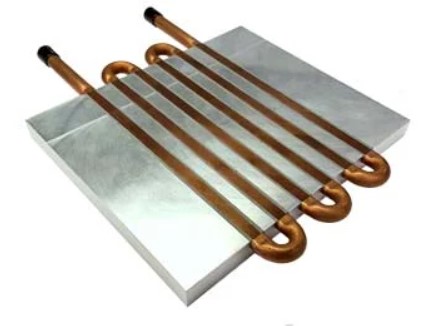
Hi-contact™ liquid cold plates utilize a proprietary pressed tube geometry within a plate to provide efficient heat transfer. This technology optimizes the contact area tubes have with the cooling surface to provide the best heat transfer into the liquid. The Hi-Contact™ construction minimizes the thermal epoxy bondline thickness enabling more heat to travel from the aluminum plate into the tube. Tubes are available in copper, aluminum and stainless steel which can be customized for various fluid paths and diameters depending upon the application.
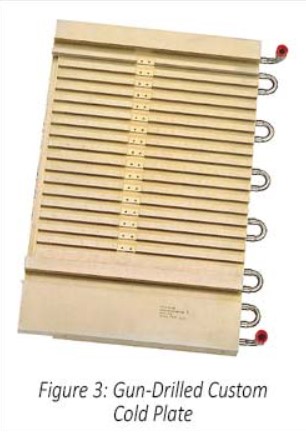
Gun-drilled cold plates are fabricated by drilling a hole through an aluminum plate and when applicable, inserting and expanding copper or stainless steel tubing. This results in dual-sided cold plates that can be drilled or tapped. One additional benefit of gun-drilled cold plates is that they can have tighter tolerances than tubed cold plates, specifically for flatness requirements (Figure 3).
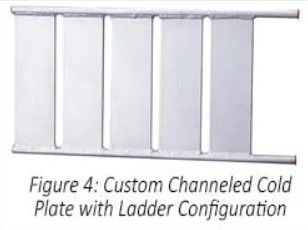
Channeled cold plates are extrusions with multi-channels, machined channels or other methods of forming channels. The extrusions can provide only straight channels, but machining and other new metal cutting methods can provide a much more efficient shape. Channeled cold plates can be manufactured in any length and assembled in a ladder configuration or integrated into a base plate for large area cooling (Figure 4). They can also be conversion coated or anodized for added protection. Eaton developed several patterns for different impedance ranges, pressure drop and flow.
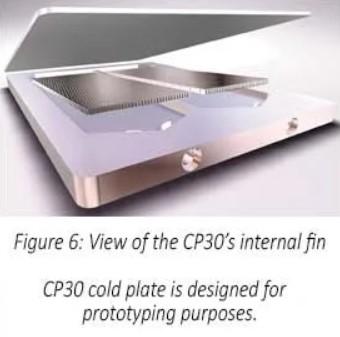
Inner-finned brazed cold plates consist of two plates metallurgically bonded together with internal fin. They can be vacuum-brazed with a variety of fin densities and shapes (plain, louvered, lanced-offset, etc.). This internal fin, such as the fin within the CP30 cold plate, adds valuable heat transfer surface and adds turbulence to the flow. Brazed cold plates generally have the most flexibility with their design. (See Figure 6.)
In addition to four types of cold plate technologies, there are also four scenarios of thermal requirements, which are listed below:
Cold plate scenarios 2 and 3 are the ones most commonly encountered in custom cold plate design. Scenarios 1 through 4 are listed in order of increasing complexity and cost.
When designing custom cold plates to any specification, the steps most thermal experts take are defining the thermal map, generating the liquid circuiting concept, calculating temperature rise and pressure drop and rerouting the liquid circuit if necessary.
With several possible thermal scenarios, step one in custom cold plate design is to define the thermal map in detail. To create a thermal map, an engineer needs the dimensions, locations and heat loads of the components to be cooled. The maximum allowable cold plate surface temperature(s); the coolant composition, its flow rate and inlet temperature; and available pressure drop are needed as well. Also, heat flux must be calculated for each component which includes thermal spreading, if necessary.
The next step is to generate the first iteration on a liquid circuit concept. The liquid circuit must provide the required performance to cool the component with the highest heat flux and each component after it on the liquid circuit. In addition, it must meet the specified flow rate at an acceptable pressure drop. Sometimes techniques such as uneven widths of liquid series passes, different fin densities under individual components and varying fin heights and types can be used to satisfy the competing requirements of performance and pressure drop. The fin’s geometry and height determine the “fin efficiency” or how well it transfers heat to the liquid.
Sometimes the shape of high heat flux components (e.g. a large round footprint) requires a change from the natural uniform flow distribution over the pass width to force non-uniformity, accomplished by using different lengths of fin or different fin densities over the pass width. Before the next component, designers may add liquid equalizing or mixing pools. Another fluid distribution challenge is adding islands in the flow path to support component mounting. Each of these challenges can increase the cost of the cold plate by adding fin pieces, multiple depths in a cavity, multiple fin-forming equipment set-ups and EDM cutting.
After outlining the liquid circuit concept, the thermal map should be verified by calculating the maximum surface temperature under each component and calculating the total pressure drop. All the critical thermal areas must be modeled. If any one of the requirements is not met, the liquid circuits must be reworked and the calculations rerun.
If the cold plate requires a varying maximum surface temperature (as in thermal scenario three) and normal liquid circuiting does not meet the specifications, the liquid circuit should be rerouted to deliver the coolest liquid to critical devices first or to by-pass part of the liquid directly to these components.
If the cold plate requirements specify maximum surface temperatures and temperature uniformity as in thermal scenario four, the design process is even more complex. The simplest solution to provide uniformity of maximum surface temperatures of identical components is to position the components on similar points of similar parallel liquid passages. The result should be a circuit that delivers liquid with a common temperature at sufficient flow rates to these components. Another technique that is used to provide a more uniform surface temperature across the entire cold plate is to use a counterflow arrangement. In a number of parallel channels, on a surface or on both sides of the plate, each second channel has flow in the opposite direction. For a one-side loaded or very thin cold plate, such an approach may significantly reduce surface temperature gradient. A similar effect may be delivered by organizing two separate layers of liquid.
Certain thermal or mechanical requirements may force an illogical pass of the liquid circuit, resulting in greater complexity and a higher cost cold plate. For example, applications frequently have predetermined mounting hole locations that the liquid circuit must navigate around and/or components and fluid inlet and outlet locations that are fixed, significantly limiting the options for the liquid circuit. Generally, the more flexible the design is, the easier the cold plate will be to engineer and the more savings you’ll realize. By working closely with a printed circuit board designer or electrical engineer, the thermal engineer can provide input on the spacing and positioning of components to ensure they are designed with electrical as well as thermal requirements in mind. This may significantly simplify the cold plate design and reduce cost. For more information on cold plate costs please see our article about cold plate manufacturing cost drivers.
It’s important to understand the various design techniques that allow a custom cold plate solution to meet the most challenging thermal and mechanical requirements. With thousands of permutations for a custom cold plate design, skilled engineering is key. Flexibility with the location of inlets and outlets, proper fluid circuit routing and the use of fin or channels can help to create a thermal solution that provides great value for the application. As heat loads become more and more concentrated and the space allocated for cooling becomes smaller and smaller, custom cold plates will be used more and more to meet applications’ unique liquid cooling needs. Eaton has decades of experience designing and manufacturing custom cold plates for printed circuit boards and other electronics and ensuring their high thermal performance requirements and cost limits are met or exceeded.
Learn more about our different liquid cold plate solutions in our Liquid cold plate section.
 发送电子邮件

 MyEatonFAQs


